
Driving & Parking in Zakopane
The basic rules of the road in Poland, winter driving, mountain roads, parking in town and at the trailheads, and what to ask your rental company.
Published
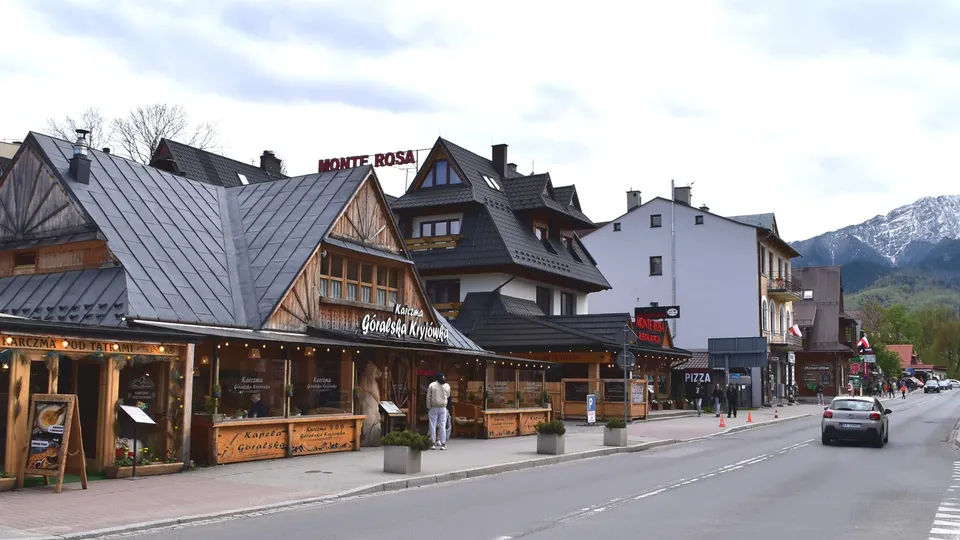
A car gives you freedom for day trips around the Tatras, but driving in Zakopane is not like driving in a city with wide roads. The main road from Kraków is busy, streets in town are narrow and steep, and winter adds snow and ice. This guide covers the basics you should know before you pick up the keys.
Check before you travel: traffic rules, speed limits, fines and parking charges change from time to time. The points below are a general overview, not legal advice - check the current rules with official sources and your rental company.
Basic rules of the road in Poland
- Drive on the right; overtake on the left.
- Dipped headlights must be on at all times, day and night, all year round.
- Seat belts are required in all seats. Children below a certain height need a suitable child seat.
- Using a phone in your hand while driving is not allowed.
- The legal alcohol limit is very low. In practice: do not drink at all if you drive.
- Pedestrians at a crossing, and those about to step onto it, have priority. Slow down near every crossing.
- Speed limits depend on the type of road: lowest in towns and villages, higher outside them, and highest on expressways and motorways. Watch the signs - the start and end of a built-up area is marked by the village name sign.
- Turning right on a red light is allowed only where there is a separate green arrow sign, and only after a full stop.
The road from Kraków
The main route to Zakopane is a single busy road through the hills. On Friday afternoons, Saturday mornings, Sunday evenings and around public holidays it can be very slow. Leave early, have water and snacks in the car, and allow extra time if you need to catch a flight on the way back.
Driving in winter
- Snow and ice are common from about November to March, and on higher roads beyond that.
- Winter tyres: ask your rental company to confirm that the car has winter or all-season tyres. Do not drive in the mountains in winter on summer tyres.
- Snow chains may be required where signs say so. Ask whether the car has them and how to fit them.
- Keep an ice scraper and a brush in the car; clear all windows and the roof before you drive.
- Braking distances on snow are much longer. Drive slowly and leave plenty of space.
Mountain roads and streets in town
- Many side streets are steep and narrow, some with sharp bends and no pavement. Drive slowly and expect pedestrians.
- Going downhill, use a lower gear rather than holding the brakes.
- Some accommodation is reached by steep access roads that become difficult after snow. Ask your host before you arrive whether a normal car can reach the house in winter.
- Horse-drawn carriages and cyclists share some roads - give them space.
Parking in town
- The centre has a paid parking zone. Pay at the machine or by a parking app, and check the signs for the hours when payment applies.
- There are many private car parks around the centre, with their own prices.
- The main pedestrian street and its surroundings are closed to cars.
- Illegally parked cars may be fined or towed.
- If your accommodation has parking, confirm how many cars it takes and whether you need to reserve a space.
Parking at attractions and trailheads
- Popular valleys and trailheads have paid car parks, which fill up early in the morning in season.
- Some roads inside the national park are closed to private cars. For the best-known mountain lake, Morskie Oko, you leave the car at the Palenica Białczańska car park, which can only be used with a reservation made online in advance.
- From there you walk, or use the transport along part of the road: horse-drawn carts on the first section and electric buses further up.
- Save your parking reservation and park ticket on your phone or print them - there is often no signal in the mountains.
- Arrive early, or use local buses and minibuses, which run to the most popular starting points.
Check before you travel: parking reservations, prices and the transport on the road to Morskie Oko are set by the national park and have changed recently.
Large SUVs and minivans
Large cars are practical for families, but many streets are narrow, parking spaces are small, and some garages have low entrances. Tell your host the size of your car when you book, and ask for exact directions for the last part of the road.
Fuel
- Petrol is marked "95" or "98", diesel is marked "ON", and gas is "LPG".
- At most stations you fill up yourself and then pay inside.
- Stations are on the main roads; some are open 24 hours. Fill up before long drives into the valleys.
Renting a car - what to ask
- Does your driving licence need an International Driving Permit to rent and drive in Poland?
- Are winter tyres included, and are snow chains available?
- How large is the deposit, and do you need a credit card in the driver's name?
- Can you take the car across the border? Slovakia is very close to Zakopane.
- What should you do and whom should you call after an accident or breakdown?
- Take photos of the car, inside and out, when you pick it up and when you return it.
Find car rental · How to Get to Zakopane
In an emergency
For accidents, call 112. A car in Poland must carry a warning triangle and a fire extinguisher; set up the triangle behind the car after a breakdown. Wearing a reflective vest when you step out is strongly recommended. Check that your rental car has all three.